Gold Buyers Malaysia: How They Test and Pay You
Last updated: 20 November 2026
1What Do Gold Buyers in Malaysia Actually Do?
Quick Answer: Gold buyers in Malaysia buy jewellery, bars, coins and broken gold for cash. At the counter they confirm who you are, weigh each piece, test its purity, remove anything that is not gold, and quote the day’s rate for that purity. If you accept, they pay you on the spot.
Most articles about gold buyers in Malaysia are lists of shops. This one looks behind the counter instead. It explains how a buyer tests your gold, which tests can be fooled, and how the number on your receipt is built line by line.
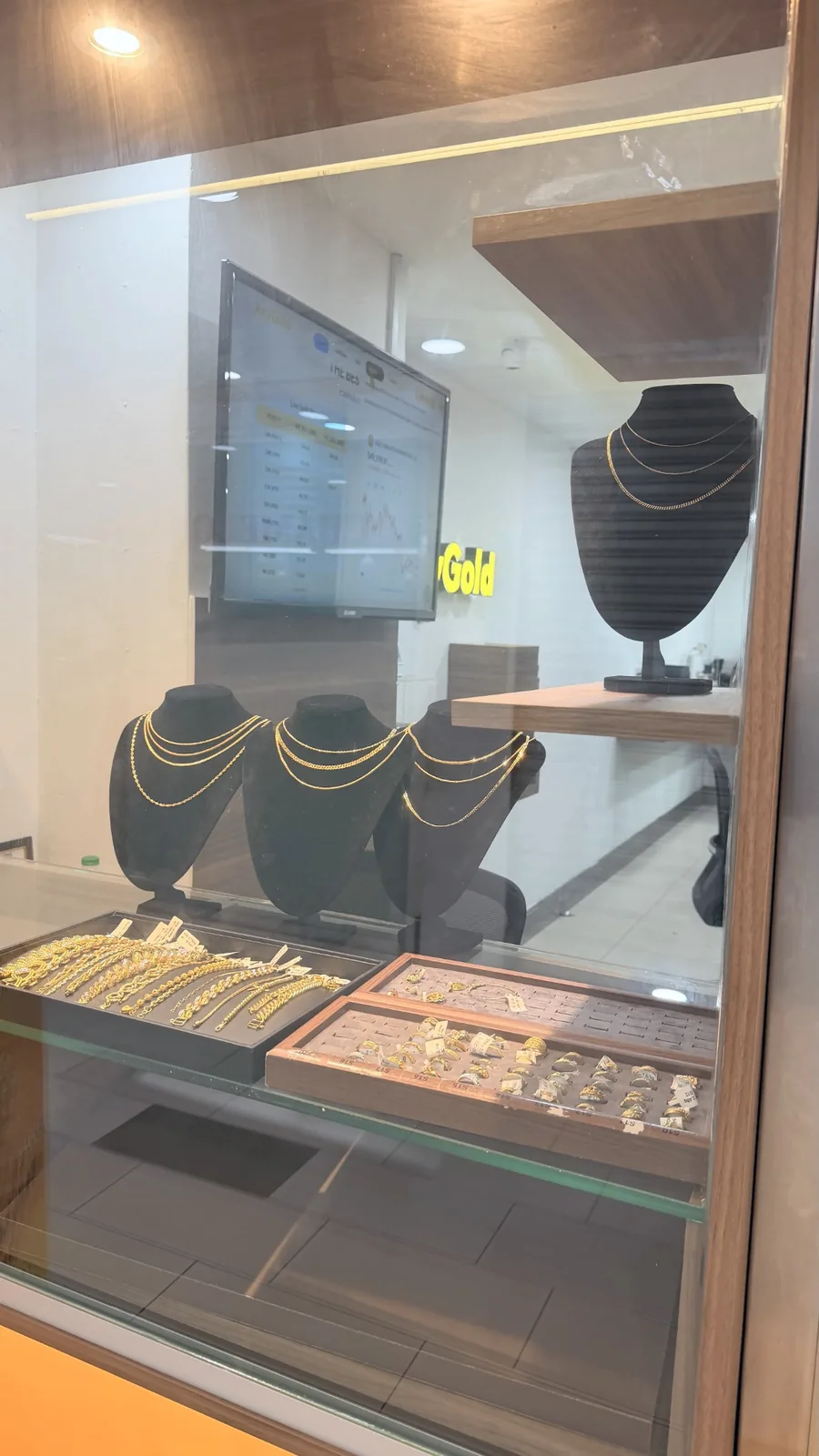
Knowing the process helps you judge any quote, wherever you sell. AnyGold, a Kuala Lumpur gold buyer at LG.142 Sungei Wang Plaza, buys every purity from 999.9 down to 375. The worked examples below use a fixed illustrative rate of RM 540 per gram of pure gold, not today’s price.
Want to see how your own gold is checked?
Visit AnyGold at Sungei Wang. Every piece is weighed in front of you, X-ray tested in our testing room, and the purity and payout are worked out with you at the counter. Plan your visit to sell gold →
The short video below shows a gold buyer’s point of view: how jewellery is checked, step by step, before an offer is made.
How We Test Gold Jewelry Before We Buy It | POV Gold Buyer
Source video: Sahara Coins & Precious Metals on YouTube
2How Do Gold Buyers Check Your Gold, Step by Step?
Quick Answer: Gold buyers check your gold in seven steps: an ID check, a stamp and visual check, a magnet screen, weighing on a certified scale, a purity test, an itemised quote and payment. The order matters, because the purity test and the net weight decide almost all of the price.
- ID check. The buyer records your IC, passport or valid ID details before any test.
- Stamp and visual check. Hallmarks such as 916 or 750, wear, colour and joins are read under a loupe.
- Magnet check. A quick screen for steel or iron cores; real gold is not magnetic.
- Weighing. Each piece goes on a certified scale; stones and non-gold parts are removed or deducted.
- Purity test. An XRF analyser, touchstone with acid, or a density check confirms the purity.
- Itemised quote. One line per piece: net weight × tested purity × the day’s rate.
- Payment. Cash or instant bank transfer once you accept, with a receipt.
The first three checks take seconds and catch obvious problems. The weighing and the purity test take longer and decide the money. If you want to prepare before you go, our seven-step guide on how to sell gold in Malaysia covers the work you can do at home.
3Which Tests Do Gold Buyers Use to Check Purity?
Quick Answer: Gold buyers in Malaysia mainly use the stamp, a magnet, a touchstone with acid, an X-ray fluorescence (XRF) analyser and, for bars or doubtful pieces, a density test. Each tool answers a different question, so a careful buyer combines two or more rather than trusting one reading.
| Method | Damages the piece? | What it detects | Main weakness | Time |
|---|---|---|---|---|
| Hallmark / stamp check | No | The claimed purity | Stamps can be faked or worn | Seconds |
| Magnet | No | Steel or iron cores | Misses non-magnetic fakes such as tungsten | Seconds |
| Touchstone and acid | Tiny streak on stone | Karat band of the surface | Can be fooled by thick plating | 2 to 5 minutes |
| XRF analyser | No | Metal mix of the surface, in % | Reads the surface, not the core | Under a minute |
| Density (water) test | No | Whether weight matches volume | Less useful on hollow or stone-set pieces | 5 to 10 minutes |
| Fire assay (refinery) | Yes, sample melted | Exact purity of the whole metal | Destroys the sample; not a counter test | Days |
Comparison by AnyGold, 2026. General guide to common methods, not a lab standard. Licence.
No single test is perfect. Acid and XRF both read the surface, so a heavy gold layer over a cheaper core can pass either one on its own. That is why a weight-for-size check matters on bars and chunky pieces. Our guide on how to check if gold is real explains the in-store tests in more detail, and the 10 ways to spot fake gold help you screen pieces at home.
4What Happens If Your Gold Tests Lower Than Its Stamp?
Quick Answer: If your gold tests lower than its stamp, a fair buyer pays the tested purity, not the stamp. On an illustrative 20 g chain stamped 916, a test reading of 87.5% instead of 91.6% lowers the payout by about RM 430. That is why you should see the reading yourself.
| Test result | Purity | Rate paid | Payout for 20 g | Gap vs stamp |
|---|---|---|---|---|
| Tests at 91.6% (as stamped) | 91.6% | RM 479.80/g | RM 9,596 | RM 0 |
| Tests at 90.0% | 90.0% | RM 471.42/g | RM 9,428 | −RM 168 |
| Tests at 87.5% | 87.5% | RM 458.32/g | RM 9,166 | −RM 430 |
| Tests at 75.0% (18K) | 75.0% | RM 392.85/g | RM 7,857 | −RM 1,739 |
Illustrative scenario by AnyGold at RM 540 per gram pure gold, buyer paying 97% of gold value, 2026. Not today’s price or a quote. Licence.
Lower readings happen for ordinary reasons. Old pieces may have been repaired with lower-karat solder, and some imported or older jewellery was simply made below its stamp. The 916 vs 999 gold purities guide shows what each stamp should contain. If a reading surprises you, ask for a second test on a different spot before you agree.
5Why Do Gold Buyers Ask for Your ID?
Quick Answer: Gold buyers ask for your IC, passport or valid ID because checking ID for every sale is standard practice in the gold trade. The record also protects you: it proves the sale was yours if a question ever comes up later.
The buyer verifies who you are and keeps a record of the transaction. Expect these checks:
- Identity. Your IC, passport or valid ID is checked and its details are recorded.
- Ownership questions. The buyer may ask where the pieces came from, especially for large sales.
- Receipt. You get a written record of weight, purity, rate and amount.
A buyer who skips the ID step is not doing you a favour. It is a sign to walk away, as our 8 signs of a trusted gold buyer in Malaysia explain.
6How Do Gold Buyers Calculate Your Payout?
Quick Answer: Gold buyers calculate your payout as net gold weight × tested purity × the day’s rate, one line per piece. Stones and steel parts are taken off the weight first. In our illustrative three-piece example, 33 g of jewellery becomes 31 g of gold and a payout of about RM 14,509.
| Piece | Gross weight | Non-gold deducted | Net gold weight | Tested purity | Rate (RM/g) | Payout |
|---|---|---|---|---|---|---|
| 916 bangle | 20.0 g | 0.0 g | 20.0 g | 91.6% | RM 479.80 | RM 9,596 |
| 916 pendant with stone | 8.0 g | 1.2 g | 6.8 g | 91.6% | RM 479.80 | RM 3,263 |
| 750 ring with stones | 5.0 g | 0.8 g | 4.2 g | 75.0% | RM 392.85 | RM 1,650 |
| Total payout | 33.0 g | 2.0 g | 31.0 g | Per line | Per line | RM 14,509 |
Illustrative scenario by AnyGold at RM 540 per gram pure gold, buyer paying 97% of gold value, 2026. Not today’s price or a quote. Licence.
Every line on a fair quote can be checked with a calculator. If a quote shows one total with no weights or purities, ask for the breakdown. AnyGold charges no commission and pays weight × the live rate for each purity, as its FAQ explains. For rings, chains and bangles in particular, see our guide to selling gold jewellery in Malaysia.
Want an itemised quote for your gold?
Message AnyGold for a live quote built on the day’s rate and your gold’s tested purity. Ask AnyGold for a live gold quote →
7How Much of the Gold Price Do Buyers Pay?
Quick Answer: Gold buyers pay a share of the gold value and keep the rest as their margin, which covers refining, testing and price risk. A couple of percentage points sounds small, but on an illustrative 50 g of 916 each point is worth about RM 247, so compare buyers on the payout, not the slogan.
| Buyer pays | Your payout | Kept by buyer | Share paid |
|---|---|---|---|
| 93% of gold value | RM 23,001 | RM 1,731 | 93% |
| 95% of gold value | RM 23,495 | RM 1,237 | 95% |
| 97% of gold value | RM 23,990 | RM 742 | 97% |
| 99% of gold value | RM 24,485 | RM 247 | 99% |
Illustrative scenario by AnyGold at RM 540 per gram pure gold, 50 g of 916 (gold value RM 24,732), 2026. Margins shown are examples, not any shop’s actual rate. Licence.
The margin is not hidden if the buyer shows you the rate. Compare the rate per gram they pay for your purity with the live market rate on the same day; the gap is the margin. Our guide on getting a top payout when you sell gold shows how preparation adds to that.
8How Do Gold Buyers Pay You in Malaysia?
Quick Answer: Gold buyers in Malaysia usually pay in cash or by instant bank transfer as soon as you accept the quote. Large amounts are often paid by transfer for safety. Either way, you should leave with a receipt listing each piece’s weight, purity, rate and the total paid.
- Cash. Fast and simple for small and medium sales; count it at the counter.
- Instant bank transfer. Safer for larger amounts; check it has arrived before you leave.
- Receipt. Keep it; it is your record of the sale and the rate.
AnyGold pays in cash or by instant bank transfer, after weighing your gold in front of you and walking you through the purity result from its testing room. You are never obliged to sell once you see the quote.
9Red Flags When a Gold Buyer Tests Your Gold
Quick Answer: The main red flags are a buyer who will not show you the test reading, uses a scale you cannot read, gives one lump price for mixed pieces, or will not explain a low reading. Any of these makes the payout impossible to check, so take your gold and leave.
- No reading shown. You should see every test reading and have the purity result explained.
- A hidden scale. Trade scales are covered by the Weights and Measures Act 1972; ask to see the display.
- One price for everything. Mixed purities need one line each.
- Pressure to decide now. A fair quote still holds up after you check it.
- Scratching or cutting without asking. Any test that marks a piece needs your consent first.
Most of these red flags disappear when the buyer works in the open, which is the core of choosing a trusted gold buyer.
10Conclusion: See the Reading, Check the Maths
Gold buyers in Malaysia all follow the same basic routine: ID, stamp, weight, purity test, quote and payment. What separates a fair buyer is whether you can see the weighing and the test reading, and check each number.
Ask which test was used, look at the reading, and recalculate one line of the quote. When you are ready to sell, AnyGold weighs every piece in front of you at Sungei Wang Plaza and explains the purity result.
11Frequently Asked Questions
1. How do gold buyers in Malaysia test gold?
They read the stamp, screen with a magnet, then test purity with an XRF analyser, a touchstone and acid, or a density check. Careful buyers combine two methods.
2. Will a gold test damage my jewellery?
XRF, magnet and density tests do not damage the piece. A touchstone test leaves only a tiny streak on the stone, and the buyer should ask before doing it.
3. Why do I need ID to sell gold?
Checking ID for every sale is standard practice for gold buyers. Bring your IC, passport or valid ID.
4. What if my gold tests lower than its stamp?
A fair buyer pays the tested purity. Ask to see the reading and request a second test on another spot if it surprises you.
5. How do gold buyers pay?
Usually in cash or by instant bank transfer as soon as you accept, with a receipt listing weight, purity, rate and total.
Want a clear, itemised quote for your gold?
Contact AnyGold at LG.142 Sungei Wang Plaza, Bukit Bintang. We buy gold of all purities, weigh it in front of you, explain the purity result and pay on the live rate.
Contact AnyGold today →